

















$860,000 in real estate equity. A five-property portfolio was losing approximately $51,000 a year.
The numbers that looked fine on the surface told a different story under a complete analysis.
Read the case study

For Households 50+ Who Own Investment Real Estate
Many financial advisors plan around your investment portfolio and treat your real estate as a footnote. I seek to analyze both together: properties and portfolio, taxes and retirement, risk and income, and build advice that accounts for all of it.
Rich Arzaga, CFP®, CCIM
Financial advice that speaks real estate™
Properties and portfolio. Taxes and retirement. Risk and income. We believe that each piece is in its right place, the whole plan works.
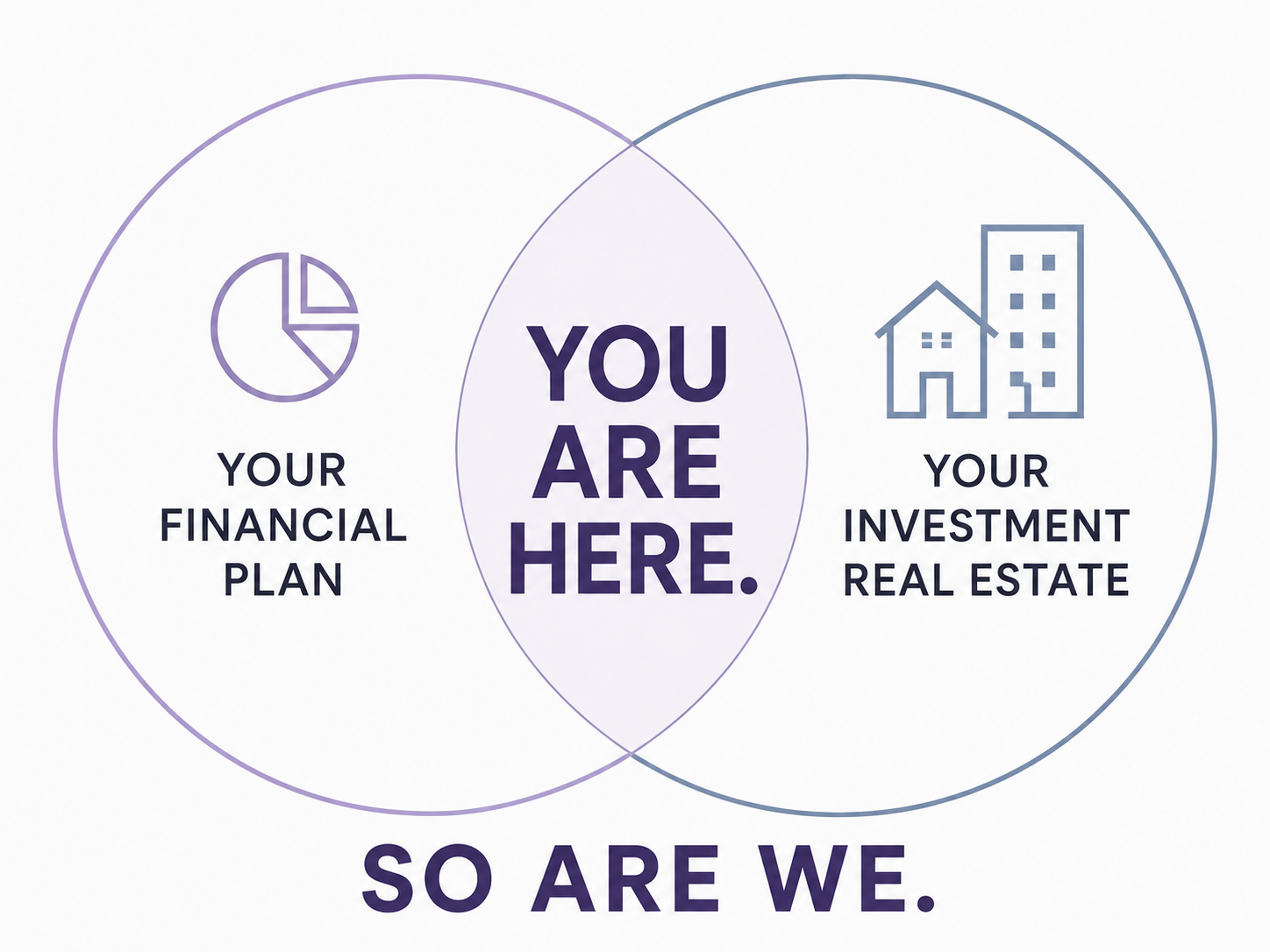
You've spent years building more than an investment portfolio. But many financial advisors are built around one, and treat your real estate as something to work around.
Your financial life may include rental properties, retirement accounts, taxable investments, a business, insurance, Social Security and an estate plan. We have seen that the decisions you make about one can change what happens to the others.
That's where I come in. I bring investment real estate into the same financial conversation as everything else you own, and seek to help you understand the tradeoffs, compare potential alternatives and make decisions based on your whole financial life.
One integrated approach
Real estate knowledge. Financial planning expertise. One conversation.
As a CFP® professional and CCIM, I bring comprehensive financial planning and investment real estate analysis together through The Real Estate Income Lab®, where the art of understanding the investor and the science of analyzing the investment work together.
Three things come together whenever a client brings me a property decision or a real estate question:
Understanding a property starts with understanding the investor. We talk through the property, the strategy, what's working, what's not, why you own it and what you're trying to accomplish. We believe that experience matters here, because the numbers don't always tell you what is actually happening.
Then we go beneath the surface numbers. We have seen that gross rent and positive months don't necessarily tell you what a property contributes over an entire year. We analyze cash flow, expenses, vacancy, debt service, capital improvements, NOI, cap rate, equity and other measures to better understand how the property is actually performing.
Then we bring the real estate advice into your financial plan. What happens if you do nothing? What if you improve the property, refinance it, sell it, exchange it or invest the equity differently? Where appropriate, we model alternatives so you can see the potential impact on cash flow, taxes, retirement and the rest of your financial life.
That's The Real Estate Income Lab®: turning real estate data into information, information into insight, and insight into better-informed financial decisions.
You know what the planning engagement costs before we begin.
I don't manage your investment accounts or charge a percentage of your assets. You can keep the investment professionals and other advisors you already work with.
My role is to analyze, advise and help coordinate the pieces, question assumptions, compare alternatives, quantify the tradeoffs where possible, and help you make informed decisions.
When a question reaches beyond my role, I can work with your tax professional, attorney, investment advisor, insurance professional or other specialists to help connect the advice.
Quoted in
We have seen that financial questions don't stay in neat categories.
You may start with a question about a property, retirement or taxes. But the answer can change when you consider how that decision impacts the rest of your financial life.
Questions like:
These may sound like separate questions. We believe, they often aren't. A decision about one part of your financial life can change what makes sense somewhere else.
Real estate can make this particularly difficult because we have seen over many years that perceived performance and actual performance are often not the same.
I call this The 5% Real Estate Performance Gap®, the potential difference between what an owner believes a property is producing and what a disciplined analysis actually shows, a gap that tends to come from optimistic assumptions, inconsistent tracking, and the absence of systematic measurement.
In my work with real estate owners, that difference has many times been 5 percentage points or more. And even a seemingly small performance gap can have a significant effect when substantial equity and many years are involved.
The question you start with may not be where the biggest opportunity is found.
See More Questions We Help AnswerThe question you bring in may not be where the answer is found.
Our experience has been that looking at your entire financial life, and looking beneath the surface of your real estate, can uncover things that aren't always visible when properties, investments, taxes and retirement decisions are considered separately.
That's where analysis becomes advice.
$860,000 in real estate equity. A five-property portfolio was losing approximately $51,000 a year.
The numbers that looked fine on the surface told a different story under a complete analysis.
Read the case studyA family home that seemed necessary to fund retirement.
The analysis showed they didn't need to sell it at all.
Read the case studyMillionaires who didn't feel like they were getting ahead.
Their assets told one story. Their complete financial picture told another.
Read the case studyWe believe that good advice starts with understanding what you're trying to accomplish.
You don't need to know exactly what kind of financial planning you need, or arrive with all the right questions. We start with what's on your mind, then determine what needs a closer look.
We start with your questions.
We talk about what you're trying to accomplish, the decisions you're facing and the things you're concerned about. If I believe I can help, we'll define the scope of the work and agree on a flat fee before moving forward.
I look at the whole picture.
My goal is to analyze the relevant pieces of your financial life together, including real estate, investments, retirement, cash flow, taxes, insurance and estate planning. When investment real estate is part of the question, The Real Estate Income Lab® process allows us to go deeper into the property numbers and then bring that analysis into the financial plan. I question assumptions, compare alternatives and quantify the potential impact where possible.
You get advice you can act on.
I will help you understand what I recommend, why I recommend it and what to do next. When implementation involves another professional, I can work with your tax professional, attorney, investment advisor, insurance professional or other specialists to help coordinate the pieces.
Start with a conversation.
You don't need to gather financial statements or documents for our initial meeting. Just bring what's on your mind.
Talk to RichGoogle Reviews
Financial advice is personal. Clients often come to me with complicated questions, important decisions and financial pieces that haven't always been looked at together.
Here are a few things they've said about the experience.
Financial Planning
“Having the numbers clearly laid out helped us understand the long-term impact and gave us much more confidence in our decisions.”
Good advice should leave you with more than answers.
You should understand your choices, why a recommendation makes sense, and feel better equipped to make the decisions ahead.
This testimonial was provided by a current client of Whisper EDU, LLC dba The Real Estate Whisperer®. The client was not compensated, directly or indirectly, for providing this testimonial. The statements reflect the client's personal experience and opinions and may not be representative of the experiences of other clients. No guarantee is made that other clients will have similar experiences or achieve similar results.
Short answers to the questions we hear most. Open any question for the fuller answer.
I am a fee-only financial planner, which means my compensation for financial planning comes directly from the fees you pay me, not from investment products, asset management fees, or any percentage of the money you have invested. I do not manage investment accounts, which means I have no financial incentive tied to where your money is held or how it is allocated.
Our flat-fee compensation structure is designed to reduce certain conflicts of interest associated with asset-based compensation and investment product sales. When I make a recommendation, it is because I believe it is the right recommendation for your financial plan, not because it benefits me. However, like all financial advisory arrangements, our services may involve other conflicts of interest, which we seek to identify, disclose, and appropriately address.
My fees are based on the scope of your situation and the work involved, not on how much money you have invested. That means my compensation doesn't change based on whether your portfolio goes up or down, and I have no financial incentive to recommend that you move assets under my management.
For most comprehensive financial plans, fees range from $8,000 to $14,000. In a limited number of cases involving extraordinary complexity, work may be billed hourly.
For a fuller explanation of how fees are structured, what's included, and a way to think about the value of the fee relative to what's at stake in your financial plan, see the Fees section of the FAQ.
Many financial planning practices are built around investment portfolios. This practice is built around the recognition that for some families, directly held real estate represents an enormous and often underplanned part of their wealth.
I analyze investment real estate as part of the comprehensive financial plan: evaluating its actual performance, integrating it with retirement planning, taxes, and investment strategy, and helping clients make informed decisions about whether to keep, sell, refinance, or exchange properties.
I also teach Real Estate Investments for Financial Planners through UC Berkeley Extension, a course designed for financial professionals who want to understand how to analyze investment real estate alongside a client's broader financial life.
Traditional financial planning tools are designed around investment portfolios. A rental property doesn't arrive with a ticker symbol or a standardized statement. It has to be analyzed: its income, expenses, cash flow, debt, depreciation, return on equity, tax exposure, management demands, and available alternatives.
That analysis then needs to be integrated into the rest of the financial plan, not evaluated separately from it. A property may look reasonable on its own and could still represent a problem at the household level: too much concentration in real estate, insufficient liquidity, a weak return on the equity currently committed to it, or capital that could accomplish more elsewhere.
The opposite can also be true. That's why we feel strongly that real estate belongs inside the financial plan, not beside it.
I call it The 5% Real Estate Performance Gap®, the potential spread between the performance an owner believes a property is producing and what a disciplined review of the numbers actually shows. That gap tends to come from optimistic assumptions, costs that are tracked inconsistently or not at all, and the absence of systematic performance measurement.
Our work has shown that a few percentage points can sound manageable until you apply them to the equity tied up in the property and consider the effect over years.
One of the most frequently overlooked measures we have seen is return on your current equity. You may not be deciding what to do with the $150,000 you invested years ago. You may be deciding what to do with $900,000 of equity tied up in that property today. That's a very different question, and the right starting point for evaluating what the property should be doing for you now.
We analyze what the property is actually doing today, including its income, expenses, debt, equity, tax characteristics, and the return you're earning on the capital currently invested in it. Then we compare what we believe are realistic alternatives: continuing to own it, improving its operations, restructuring the debt, selling outright, completing a 1031 exchange, or redeploying the equity elsewhere.
Each alternative can be modeled against your overall financial plan so you can see the potential effect on cash flow, taxes, retirement income, liquidity, and long-term wealth, not just the property in isolation.
This is core to how The Real Estate Income Lab® works: bringing the art of understanding what you're trying to accomplish together with the science of what the numbers actually show.
We have seen that rental income can be a meaningful source of retirement cash flow, but it behaves differently from a dividend or a Social Security payment. It varies with vacancy, expenses, and market conditions. It comes with tax implications, including depreciation while you own the property and potential recapture when you sell. And it's tied to an asset that requires management, carries liability, and may need future capital.
Real estate equity, meanwhile, could very well represent wealth that often isn't captured in traditional retirement projections. A client with $1.5 million in investment accounts and $2 million of equity in rental properties has a very different retirement picture, but only if the plan accounts for all of it.
We seek to integrate both into the comprehensive financial plan: modeling rental income alongside Social Security, investment distributions, and other sources; evaluating how the real estate performs as a long-term income asset; and helping determine how, and when, it makes sense to hold, transition, or sell real estate holdings as you move through and into retirement.
You've worked hard to build what you have. The next step is helping you make sure your real estate, investments, retirement, taxes, insurance and estate plan are working together toward what you want.
Ready to start with a conversation?
Talk to RichA complimentary conversation with a CFP® professional about what's on your mind and what you want to accomplish.
Not ready to talk yet?
Take the Free 60-Second CheckupIs your real estate, and everything else you've built, working together to get you where you want to go?